|
|
||
| Home Page |
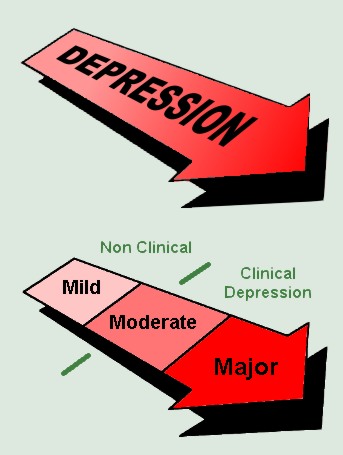
We all of us get "down" and may speak of feeling "depressed" from time to time. Some people use the word "depression" to describe feelings of sadness or loss. Although unpleasant, these feelings of being "down" or "low" will often pass within hours or perhaps days. Often there will be an easily recognisable reason for us to be down, like not succeeding in a job interview, a disagreement with a loved one or the loss of something quite important. During this time it is still possible for us to be slightly "cheered up" by our favourite things, like a good film on TV or a visit to a football match. The chances are that in these cases the "depression" being spoken about isn't really the kind of depression that causes people to seek help in counselling and psychotherapy but is simply the "down" bit of the natural ups and downs of life. In what we might call more extreme cases, the feelings of sadness and other symptoms such as social withdrawal or sleep disturbance may be severe. This may impact in a quite significant way on our ability to carry on as normal. This often happens at a time of readjustment, loss or change, such as the death of a loved one, a marital separation or redundancy. Are such cases examples of depression? And what about those people who experience low mood, a lack of energy and withdrawal from life without there being an obvious reason for their depression? In this section I want to look at depression in three ways, starting firstly with the kind of depression that will affect virtually everyone at some stage in their lives. We'll then move on to look at more serious types of depression and finally consider the medical model of depression. (See the diagram below). Click Here for the Next Page (Mild Depression) or use the Buttons on the left to skip to a specific section, including an online depression test. Back to Top |
|
|
(Information on a range of issues and problems) |
||
| Depression
Intro
(You are Here) |
||
| Mild Depression | ||
| Major Depression | ||
| Depression Facts | ||
| Medication | ||
| Symptoms | ||
| Take a Test | ||
|
Depression can have a number of causes. It is
experienced in a range of forms, of varying severity. Symptoms also vary,
becoming more and more disruptive in the life of the sufferer as the depression
has a greater and greater impact on their life.
Medical professionals tend to categorise the different levels of depression, referring to the depression as 'clinical depression' once a certain type and number of symptoms are experienced for a particular length of time. Different experiences of depression are discussed on this and subsequent pages, together with some of the therapeutic options relevant to each type.
|
||